News
Nigeria Launches Electric Tricycle Scheme Across 12 Federal Universities

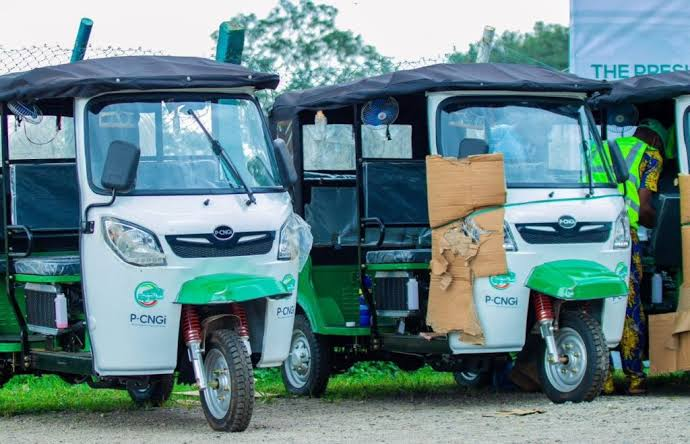
The Federal Government (FG) on Monday launched the Renewed ‘Hope Campus Transport Scheme,’ with a first batch of 240 electric tricycles in 12 federal universities across the six geopolitical zones.
The Minister of Education, Dr. Tunji Alausa, described the initiative as a major step in making student mobility safer, cheaper and fully powered by clean energy.
At the flagship event, held at the University of Lagos (UNILAG), the minister stressed that the initiative was driven directly by President Bola Ahmed Tinubu’s commitment to students’ welfare.
According to him, “The president holds the youth of this country in the highest esteem. You have a president today in the person of President Bola Tinubu, who believes so much in what education does to any society, and that’s why this president has funded education in this country as no other president has ever done in the history of our country.”
He stated that a total of 240 solar-powered electric tricycles had been deployed across the federation, with 20 units each distributed to 12 federal universities, along with a solar-powered charging station at each school.
“The benefiting universities in this first phase were selected across the six geopolitical zones: in South-West: University of Lagos (UNILAG) and University of Ibadan (UI); South-East: University of Nigeria Nsukka (UNN) and Federal University of Technology Owerri (FUTO); South-South: University of Benin (UNIBEN) and University of Uyo (UNIUYO); North-Central: University of Abuja (UNIABUJA) and Federal University of Technology Minna (FUTMINNA); North-East: University of Maiduguri (UNIMAID) and Modibbo Adama University (MAUTECH) and in North-West, we have the Ahmadu Bello University (ABU) Zaria and Bayero University Kano (BUK).”
Alausa emphasised that ownership rests entirely with the student unions. “Let me emphasise clearly that these tricycles are being donated by the Federal Government directly to the student union of each of the beneficiary institutions. These tricycles are for the students,” he said.
He also announced additional interventions, including the rollout of conversion kits under the Presidential CNG Initiative and a forthcoming 11MW solar mini-grid for UNILAG.
“We’ve made provision for almost 2,000 conversion kits. Those conversions will be done at no cost. President Tinubu has already paid for that,” he explained.
On power infrastructure, he added, “We also will be starting the project of putting this university off-grid, building a mini solar grid of almost 11 megahertz, and before the end of this year, I promise you I’ll do everything possible to come back to the campus to commission it.”
He concluded by reaffirming the government’s commitment: “This is Renewed Hope in action; practical, measurable, and impactful.”
In her reaction, UNILAG Vice Chancellor, Prof. Folasade Ogunsola, described the launch as an important step in the school’s transition toward full green mobility.
She said, “It is an honour to welcome you all to the launch of the Renewed Hope Campus Transport Scheme of the electric tricycle under the Renewed Hope agenda.”
She praised the president and minister for the effort. “We thank President Bola Ahmed Tinubu for this initiative, and the Minister of Education, Dr Tunji Alausa, our own distinguished alumnus, for his continued drive in creating the new narrative in the education sector.”
The VC highlighted UNILAG’s earlier adoption of electric buses, noting their environmental gains.
“For us at the University of Lagos, today is another milestone in our bid to have a green environment. With this addition, we will be able to cut over 120 metric tons of CO₂ emissions by the end of this year,” she said.
She also applauded IRS Green Energy, saying, “We thank, in particular, the Chairman of IRS Green Energy Limited, Alaji Isiakwu Rabiu, for delivering the tricycles on time, which we have now allocated to our students and to a few units in the university.”
Ogunsola assured the minister of accountability, adding, “We can assure you that we will use the tricycles judiciously.”
In another development, Alausa also paid a visit to the Lagos T-VET Centre, a Programme Targeting 960,000 Verified Youths
Following the UNILAG launch, the minister visited a Technical and Vocational Education and Training (TVET) centre in Lagos, where he briefed journalists on the scope of the nationwide vocational programme.
He explained that the visit was part of oversight on the massive national skills initiative recently rolled out.
“The visitation is all about a technical vocational education trainee that was rolled out, a programme that is designed to give our teaming youth life skills, for them to be able to contribute to their society, to the country and the world at large,” he told reporters.
According to him, the programme was personally ordered by President Tinubu. “President Bola Tinubu directed us that we need to start giving our children the life skills that they need. He provided adequate funding for us.”
Alausa said the government selected priority skill areas based on national needs. “With our own mapping analysis, fashion and garment making was number one, almost across the country. Livestock farming, solar photovoltaic installation, electrical installation, computer and GSM repair, as well as plumbing and air conditioner repair. We had almost 28 skills,” he stated.
He explained that the T-VET programme was designed in four phases, covering training fees, support for training centres, and post-training empowerment. “We would pay the students to go for the training. We’re paying the skill training centres. We’re also paying the Vocational Enterprise Institute. Every single student will get a starter pack to help them start,” he said.
He added that the goal was to create new generations of entrepreneurs. “Our goal is to empower them to be the next micro entrepreneurs, the next small business entrepreneurs, the next medium business entrepreneurs.”
Explaining the success of the programme’s rollout, Alausa said, “Within 10 days, we had 1.3 million young Nigerians apply. As of today, we have 960,000 students verified. The first cohort, we’re training about 250,000. As of today, we have about 130,000 of these students in over 1,600 centres across 36 states and the FCT. They will start receiving their monthly stipend probably in the next few days,” he said.
The minister also emphasised quality assurance and accreditation. “We’ve carefully done this so that this becomes a standard way of training. We’ve designed it in such a way that these programmes are well-quality assured, high-quality training programmes.”
He added that the initiative aligns with Nigeria’s economic ambitions. “This is what any country needs to build our manufacturing base and meet our agenda of a $1 trillion economy by the year 2030.”