

































































A mysterious burial hidden beneath one of Britain’s most historic religious buildings for centuries may finally reveal the identity of its occupant.
For more than 150 years, archaeologists have struggled to establish who was buried inside an ancient Roman stone coffin discovered at Westminster Abbey. Now, new scientific evidence offers an extraordinary clue, suggesting the remains may belong to a prominent medieval religious leader who lived nearly 1,000 years ago.
The discovery has renewed interest in the remarkable history of Westminster Abbey and the surprising ways ancient objects were reused by later generations.
*An ancient coffin with a mysterious occupant.*
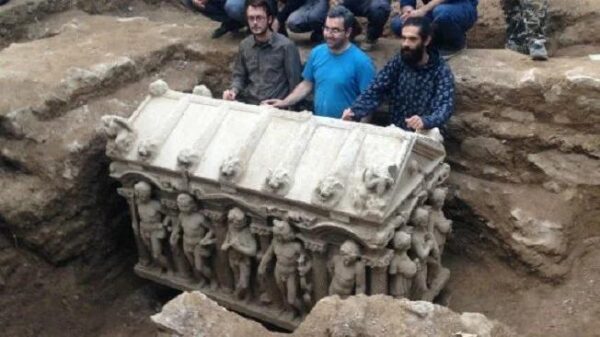
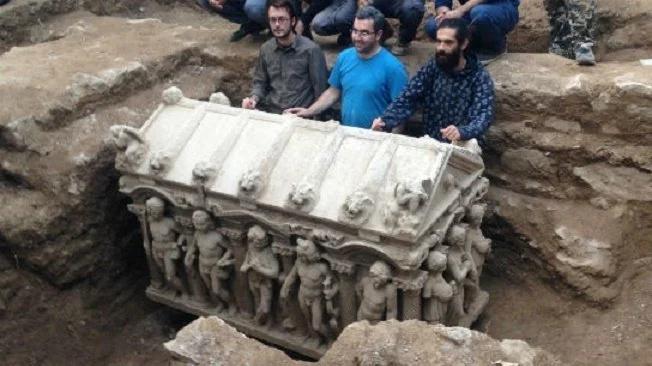
The limestone sarcophagus was formally excavated in 1869, although it had been encountered by workers decades earlier, in 1820.
What made the discovery particularly fascinating was the inscription on the coffin, which identified a Roman individual named Valerius Amandinus. Historical evidence suggests that he lived in London sometime between AD 300 and 400.
However, the inscription was only part of the mystery.
Researchers noticed a large Latin cross carved into the coffin’s lid. The cross appeared to date from approximately the 10th or 11th century, suggesting that the coffin had been reused long after the original Roman burial.
This raised an important question: Who was the person placed inside a Roman coffin centuries after its creation?
*Scientists uncover a remarkable clue*
Recent archaeological investigations have provided a possible answer.*
A fresh examination of the human remains established that the individual was a man aged approximately 35 to 49 years old. He was also estimated to have stood around five feet nine inches tall.
The most significant breakthrough came from radiocarbon dating.
A bone sample was analysed by the Scottish Universities Environmental Research Centre, producing a date range of AD 987 to 1052.
This established that the person buried inside the Roman sarcophagus lived during the late Anglo-Saxon period rather than the Roman era.
Researchers subsequently identified two possible candidates: Aelfwig and Wulnoth, both former abbots of Westminster Abbey.
Aelfwig, who died around 1020, is considered the stronger possibility by Professor Warwick Rodwell, the abbey’s consultant archaeologist. Wulnoth, who died in 1049, is another possible candidate.
Although the identity has not been conclusively established, the scientific evidence has considerably narrowed the possibilities.
*A wooden coffin hidden inside a Roman sarcophagus*
Another fascinating aspect of the investigation was the discovery of evidence suggesting that the medieval individual had originally been placed inside a wooden coffin.
Although the wooden structure had completely disappeared, its outline remained visible inside the ancient stone container. This suggests that the medieval burial involved placing a wooden coffin inside an already ancient Roman sarcophagus.
It is an extraordinary example of how valuable objects from earlier civilisations could be repurposed by later societies.
A mystery that survived generations
The investigation also revealed that the skeleton had not been permanently lost, as some researchers previously believed.
During conservation work in 2016, the sarcophagus was transported to a studio, where researchers removed its lid and discovered that the remains were still inside.
The discovery provided another opportunity to examine the skeleton and investigate the circumstances surrounding the burial.
The findings have since transformed the understanding of an archaeological mystery that has fascinated researchers for generations.
Sometimes, the greatest historical discoveries are not found in newly uncovered cities or distant archaeological sites. They are hidden in places that people have walked past for centuries.
The mysterious Roman coffin at Westminster Abbey demonstrates how modern scientific techniques can bring forgotten history back to life.
Although researchers have yet to establish the occupant’s identity beyond doubt, the possibility that a medieval abbot was buried inside a Roman coffin makes this one of Britain’s most fascinating archaeological mysteries.