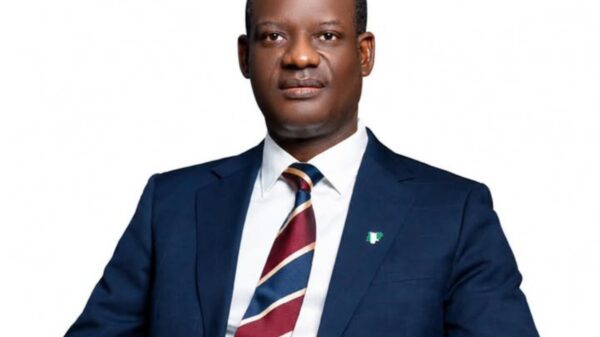








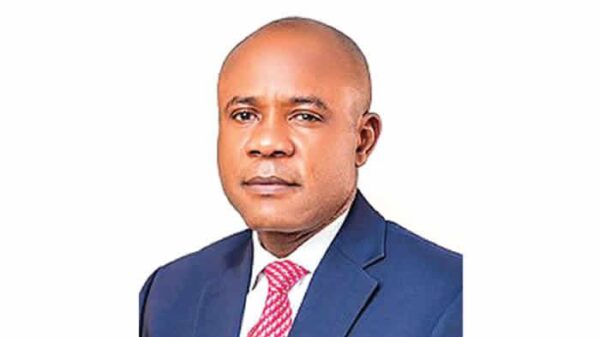




































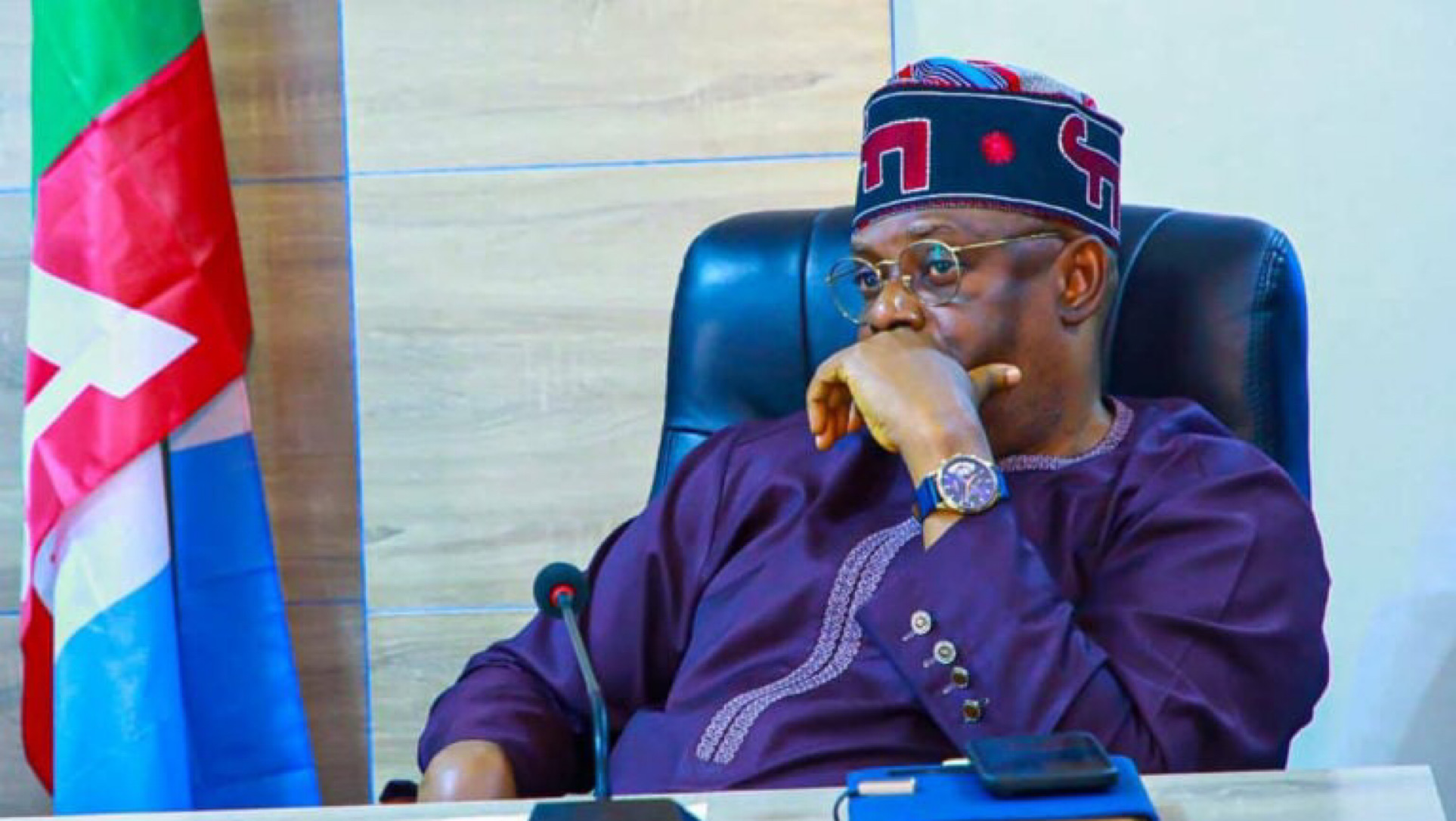








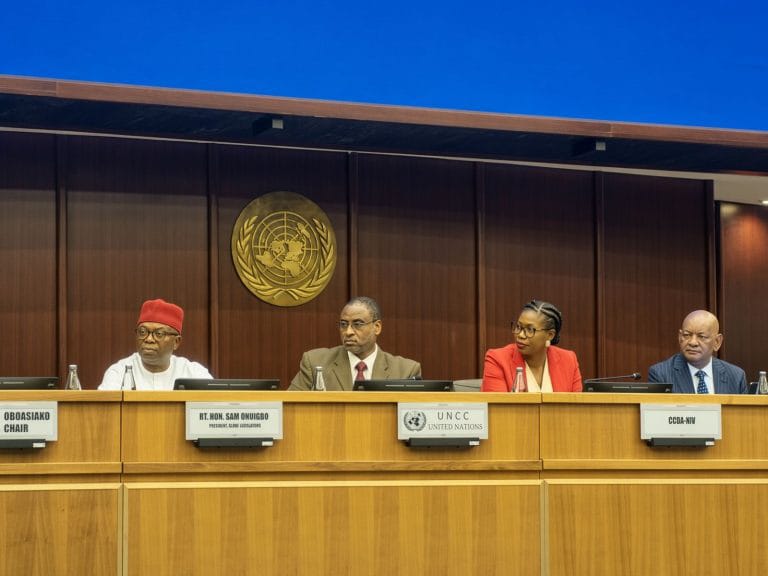
Fifty years after General Murtala Muhammed declared in this same city that “the fortunes of Africa are in our hands to make or mar,” Rt Hon Sir Sam Onuigbo told African leaders on Monday that the continent must finally answer that charge — by building, financing, and governing its climate future itself.
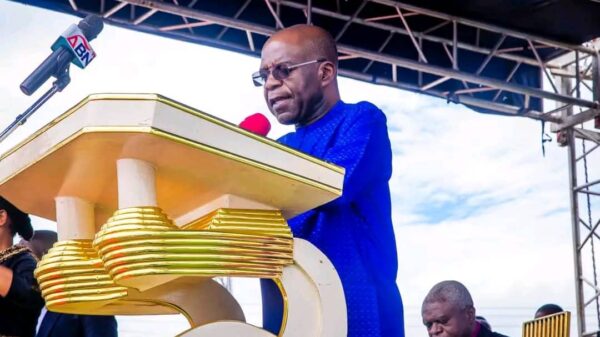
Speaking at the opening of the Fourteenth Conference on Climate Change and Development in Africa (CCDA-XIV) at the UN Conference Center in Addis Ababa, Onuigbo said Africa’s era of “participation without authorship” in global climate governance must end.
The theme of this year’s conference, *“From Pledges to Implementation: The Belém–Antalya–Addis Roadmap,”* set the tone. For Onuigbo, sponsor of Nigeria’s Climate Change Act 2021 and President of GLOBE Legislators, the conversation is no longer about whether the world believes in climate change. It is about who controls the money, laws, and projects meant to solve it.
*From Participation to Agency*
Onuigbo drew a sharp line between three words that define Africa’s current moment:
*Participation* – Africa is present at the table.
*Representation* – Africa’s interests are mentioned in communiqués.
*Agency* – Africa sets the terms, designs the instruments, and decides who assesses, approves, and disburses.
“Climate priorities describe what Africa needs. Climate agency defines what Africa decides, designs, builds, finances, governs, and defends for itself,” he said.
He warned that waiting for external validation has kept progress “slow and conditional.” Where Africa has moved first — in independence, in markets, in institutions — it has changed outcomes.
*Implementation is the New Diplomacy*
For three decades, climate diplomacy has produced conventions, NDCs, and net-zero pledges. Onuigbo argued the question for Africa is now different: Do we have the institutions, financing, technologies, and political will to implement — and who controls them?
He said NDCs must stop being diplomatic documents and become “implementation architectures”: investment frameworks, sectoral plans, and pipelines of bankable projects that answer: _what, by whom, at what cost, financed how, measured how._
Using Nigeria as an example, he cited the *Climate Change Act 2021*, which places the National Council on Climate Change under the Presidency. The goal: cut through “peer jealousy” among ministries and ensure climate policy survives elections and budget cycles.
He also pointed to Nigeria’s floods in 2012, 2022, and 2024 as proof that Africa must shift from reactive disaster response to anticipatory risk management — flood mapping, wetlands protection, early-warning systems, and climate-responsive budgeting.
*The 5 Areas Where Africa Must Write the Rules*
Onuigbo outlined where Africa must move from demand to authorship:
1. *Climate Finance Access*: African development banks and national funds should be the first point of disbursement for resources like the Green Climate Fund and Loss and Damage Fund, not just implementers of foreign designs.
2. *Just Climate Finance*: Beyond headline figures, Africa must decide what counts as climate finance, how much is grants vs loans, and ensure it does not deepen debt or dependence on outside intermediaries.
3. *Carbon Markets*: Under Article 6, Africa must not become a supplier of cheap credits while value is captured elsewhere. Carbon finance must drive industrialization, land restoration, and community benefits.
4. *Climate Trade Rules*: With carbon-border taxes rising, Africa must align climate negotiators, trade ministries, and the AfCFTA Secretariat to prevent new tariff walls against African industry.
5. *African Metrics for Adaptation*: Success should be measured by African realities — are farmers protected, are cities resilient, is food secured — not just by external indicators.
Onuigbo said the *Belém–Antalya–Addis Roadmap* must deliver concrete tools: an African Climate Implementation Compact, a project-preparation facility, a continental adaptation investment pipeline, a climate intelligence network, and a green industrialization compact.
Crucially, he said Africa must also mobilize its own capital — pension funds, sovereign wealth funds, and banks — with public money used to de-risk projects so larger investments can follow.
On energy, he stressed that a “just transition” in Africa cannot only mean emissions cuts. With hundreds of millions still without power, it must mean access, affordability, jobs, and turning Africa’s minerals, gas, and renewables into finished value chains on the continent.
“The real test of climate ambition is not the quality of the pledge, but the quality of implementation,” Onuigbo concluded. “Success will be measured by whether a farmer is protected from drought, a community has reliable energy, and a young African can build a green enterprise.”
He closed by referencing GLOBE Legislators, arguing that parliaments are where climate commitments become budgets, laws, and accountability.
Africa, home to critical minerals and vast oceans, must move from climate participation to climate agency — shaping the rules, institutions, and finance that affect its future, with international support but not control.
The CCDA-XIV runs from September 7–9 in Addis Ababa and is convened by the African Union Commission, UNECA, AfDB, PACJA, and Afreximbank.