


































































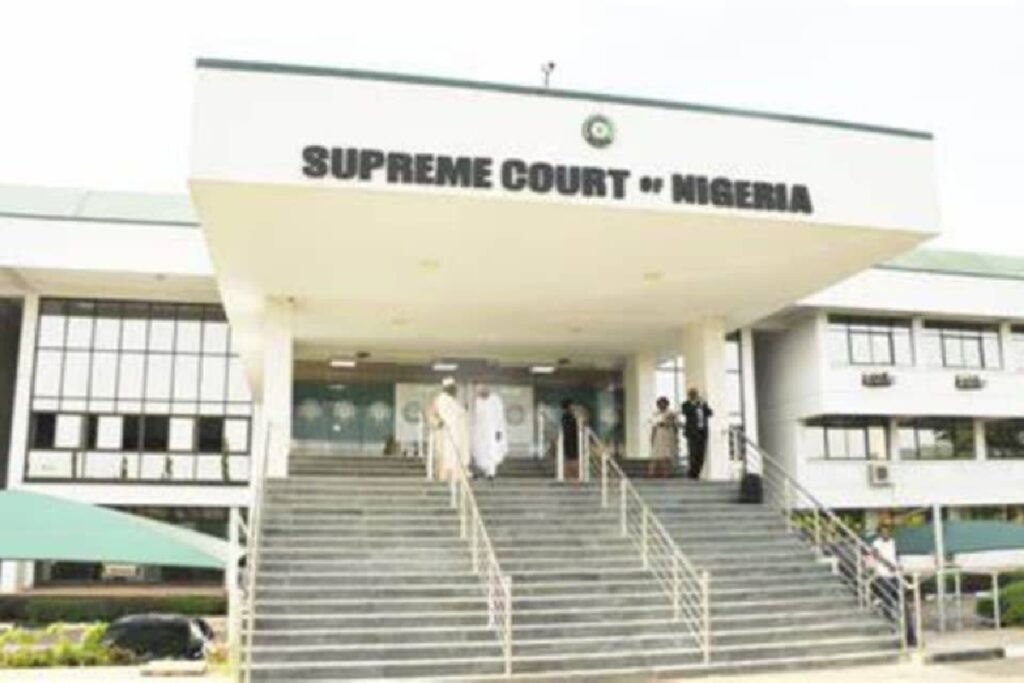
The Supreme Court has scheduled a hearing on October 22 to hear a constitutional challenge filed by at least 16 state governments against the laws that established the Economic and Financial Crimes Commission (EFCC) and two other federal organisations.
The case, SC/CV/178/2023, began with a lawsuit brought by the Kogi State Government and has since expanded to include 15 other states as co-plaintiffs.
Following the states’ admission to the complaint and the court’s issuance of permission for case consolidation, a seven-member panel led by Justice Uwani Abba-Aji set the hearing date. The states affected are Ondo, Edo, Oyo, Ogun, Nassarawa, Kebbi, Katsina, Sokoto, Jigawa, Enugu, Benue, Anambra, Plateau, Cross River, and Niger.
The states contend that the Nigerian Constitution was broken by the establishment of the EFCC and related legislation. The plaintiffs specifically argue that although the United Nations convention against corruption served as the foundation for the 2004 EFCC Establishment Act, it did not fulfil the constitutional requirement under Section 12, which requires state legislature approval for such international conventions to become domestic law.
The states used a prior Supreme Court decision in Dr. Joseph Nwobike v. Federal Republic of Nigeria as support for their positions. That decision concluded that a UN Convention was improperly incorporated into Nigerian law through the EFCC Act and did not comply with the constitution. The states contend that the anti-corruption organisation is unlawful in their territories since the EFCC Act cannot lawfully apply to them without their consent.
During Tuesday’s sessions, lawyers representing the states made their presentations. While the majority of the states wanted to be joined as co-plaintiffs, two asked for case consolidation. Abdulwahab Mohammed, SAN, counsel for Kogi State, explained the legal strategy to the court, recommending that the co-plaintiff states join and follow existing legal processes, while the states requesting consolidation submit their applications within seven days.
Justice Abba-Aji approved their pleas and postponed the case until October 22 for further hearings.
In its initial lawsuit, the Kogi State government requested nine reliefs, including a declaration that the Nigerian Financial Intelligence Unit (NFIU) and other federal agencies, including the EFCC, lacked the jurisdiction to oversee or manage state funds or look into state financial administration. The state government also raised six important questions for determination. The verdict in this case might drastically alter federal agencies’ authority over state governments in Nigeria.
A Gentle Reminder: Every obstacle is a stepping stone, every morning; a chance to go again, and those little steps take you closer to your dream.
Nnamdi Okoli