






















































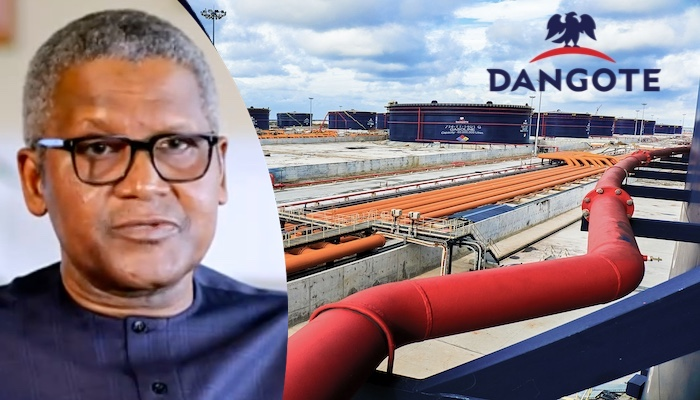
Indications emerged on Thursday that the Nigerian National Petroleum Company Limited (NNPC) and the leadership of the Dangote Refinery may be making progress in their three-week negotiations on in-country fuel supply, with the national oil company now requesting to deploy its permanent monitoring team at the facility as part of the deal between the two entities.
Also, it was learnt that the President of Dangote Group, Aliko Dangote, has now accepted to sell the refined petrol from his 650,000 barrels per day refinery in Nigeria’s local currency, the Naira, as part of the agreements reached with the NNPC.
Vice President, Oil and Gas, Dangote Industries Limited, Devakumar Edwin, disclosed this during an X Space event hosted by ‘Nairametrics’ and monitored by THISDAY.
Edwin, at the session, discussed the progress made by the refinery in the production of Premium Motor Spirit (PMS) commonly known as petrol, stressing that the NNPC had informed the management of Dangote Group of its intention to station a team of six to 10 people permanently at the $20 billion refinery.
Edwin said NNPC told the management of the refinery that the team would be overseeing the production and buying back the products in Naira since the national oil company would be supplying the crude.
He added that the request aligns with the NNPC’s aim to closely monitor the entire process, ensuring consistent crude supply and efficient processing while securing a steady flow of PMS for the country.
“NNPC has informed us that they intend to station a team of six to 10 people permanently at our refinery. They’ve asked us to provide office space for them since they will be supplying the crude, overseeing the production, and buying back the products in Naira.
Edwin also expressed frustration over the seeming boycott of Dangote Refinery’s products by local marketers, revealing that despite the refinery’s efforts to supply affordable petroleum products, many traders in Nigeria have refused to purchase from the facility, preferring to continue importing refined products from abroad.
“This request aligns with the NNPC’s aim to closely monitor the entire process, ensuring that crude is supplied and processed efficiently while securing a steady flow of PMS for the country,” Edwin stated.
Providing further information on the production and commercial arrangements at the refinery, Edwin noted that the discussions with the NNPC revolved around a new model for crude supply where the refinery will buy crude from the government in Naira and sell PMS in the same currency, rather than in dollars.
He noted that the negotiations were ongoing, with critical aspects like crude pricing and the Naira exchange rate yet to be finalised.
“We are still in talks with the government about receiving crude in Naira. The discussions are ongoing, and nothing has been finalised yet. Some unresolved issues include the pricing of crude, the pricing mechanism, and determining the appropriate exchange rate for the Naira,” he said.
But Edwin explained that Aliko Dangote had agreed to the federal government’s proposal to sell products from the NNPC to the government in Naira, despite the likelihood of financial losses.
According to Edwin, Dangote highlighted the critical need for foreign exchange and the deteriorating value of the Naira as key factors in his decision to proceed with the deal.
“Dangote intervened and said: ‘’We are going to accept this because the country desperately needs foreign exchange, and the value of the Naira is deteriorating every day. I understand that I am going to take a loss – because, by the time we sell the product and convert it to dollars, the exchange rate may have worsened.”
Edwin also expressed frustration over the seeming boycott of Dangote Refinery’s products by local marketers, revealing that despite the refinery’s efforts to supply affordable petroleum products, many traders in Nigeria have refused to purchase from the facility, preferring to continue importing refined products from abroad.
He said: “The whole purpose of doing this refinery in Nigeria was to utilise our local crude instead of exporting raw materials and importing finished products. We should be able to refine and use the finished products within Nigeria and produce more to export the surplus.”
But the Dangote Industries Limited (DIL) vice president stated that despite the refinery’s large production capacity, local marketers were only purchasing about 3 per cent of the output.
According to him, the remaining 97 percent of the refinery’s production, including diesel and jet fuel, was being exported due to a boycott by local traders who refuse to buy at the refinery’s lower prices.
“I’m selling 2 to 3 per cent to small traders who are willing to buy, while the rest 95 to 97 per cent I’m forced to export,” suggesting that some marketers prefer to import for reasons he did not state.
In a bizarre twist to the entire story, Edwin disclosed that oil marketers wrote to President Bola Tinubu, complaining about the refinery’s pricing strategies, especially for reducing the rate Nigerians buy diesel.
He explained: “They wrote to His Excellency, the president, claiming that we are disturbing the market by dropping our prices,” expressing concern over the continuing resistance by the marketers.
According to him, the refinery can produce up to 54 million litres of refined petroleum products per day, depending on crude oil supply, but lamented that local crude supplies had been inconsistent, forcing the refinery to rely on imported crude from countries like the US and Brazil.
Edwin added that the situation was further worsened by International Oil Companies (IOCs) which prefer to prioritise foreign markets and selling crude oil at prices above the market rate.
He disclosed that just 44 per cent production of the refinery was enough to meet Nigeria’s petroleum needs, while the rest could be exported.