





































































Time management is one of the most thoroughly explored topics in productivity. There are systems, frameworks, apps, and entire industries dedicated to the optimal organization of the hours in a day. And yet the experience of most people who implement these systems is that the hours are accounted for but the output is still inconsistent, the focus is still fragmented, and the end of a well-scheduled day can feel just as depleted as the end of a chaotic one. The missing variable in almost every time management conversation is energy.
To manage your energy not just your time is to recognize that two identical hours on a calendar are not actually identical. An hour of work done in a state of full cognitive engagement and genuine motivation produces significantly more and better output than an hour of work done in a state of depletion, distraction, or forced effort. Time is fixed. Energy is variable. And managing the variable one changes what the fixed one can produce.
Why Time Management Alone Is Not Enough
The reason so many time management systems fail to deliver the results they promise is that they treat all time as equivalent when it demonstrably is not. To manage your energy not just your time is to acknowledge that your cognitive, emotional, and physical capacity fluctuates throughout the day, the week, and across seasons of life, and that working with those fluctuations rather than against them produces both better output and better wellbeing.
How to Manage Your Energy Instead of Just Your Time
1.Identify your high-energy periods and protect them for your most important work. The single most impactful way to manage your energy not just your time is to know when your energy peaks and to protect that time for work that requires your best thinking. For most people, this is in the morning, but it varies significantly. Doing your most demanding work in your peak-energy window and your least demanding in your low-energy one is a simple shift that produces disproportionate results.
2.Treat physical energy as the foundation of everything else. To manage your energy not just your time, physical energy, produced by adequate sleep, regular movement, proper hydration, and consistent nutrition, is the foundation on which cognitive and emotional energy rest. Managing any of the other energy dimensions without addressing the physical one is building on an unreliable base.
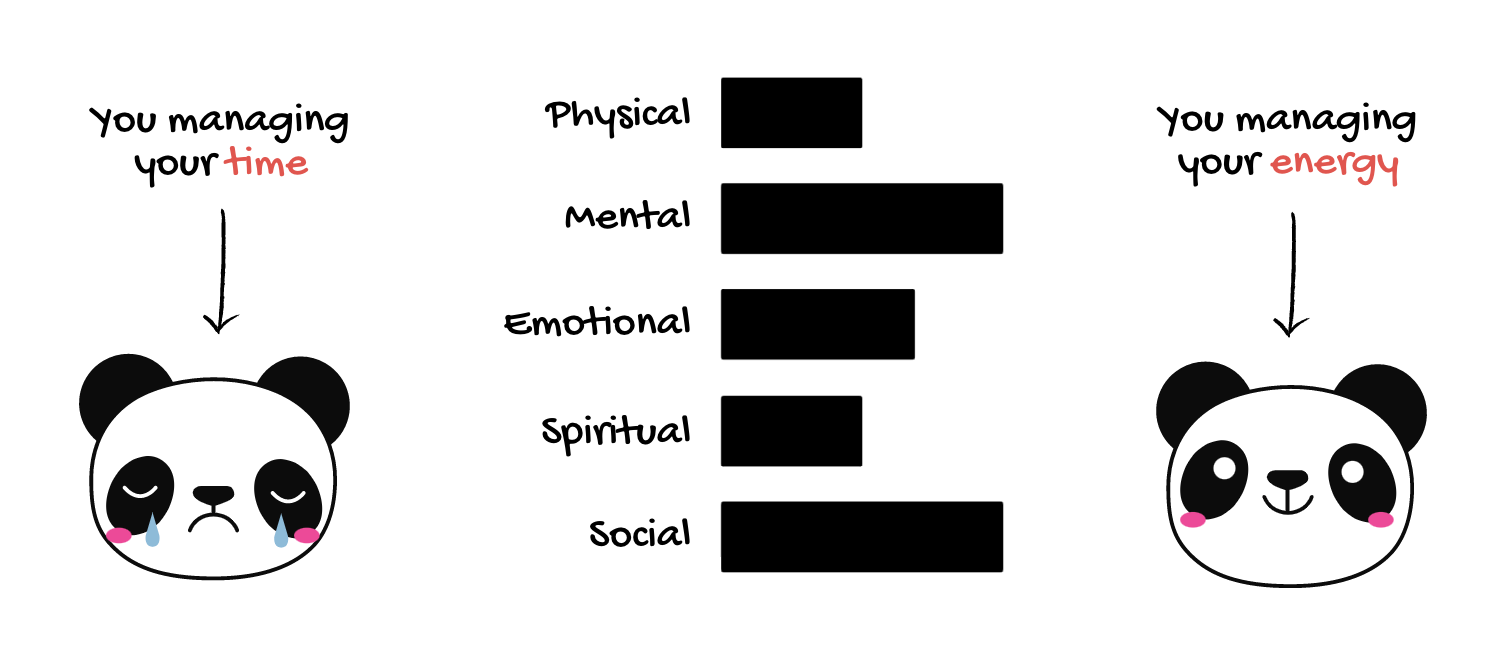
3.Recognise the four dimensions of energy and manage all of them. Physical energy is one dimension of a complete energy picture. To manage your energy not just your time effectively, you also need to manage your emotional energy, the degree to which relationships and interactions restore or deplete you; your mental energy, the capacity for sustained focus and complex thinking; and your purpose energy, the motivational fuel that comes from working on things that genuinely matter to you.
4.Build genuine recovery into the structure of your day. To manage your energy not just your time, recovery is not what you do after the day is done. It is what you do throughout it. Brief, genuine departures from cognitive effort, a short walk, a real lunch break, a few minutes of stillness, maintain energy across the day in ways that pushing straight through never can.
5.Match the type of work to the type of energy available. Not all work requires the same kind of energy. Creative work requires a different state than administrative work, which requires a different state than relationship-focused work. To manage your energy not just your time, learn to match your tasks to the energy state you are actually in rather than forcing every type of work into every part of the day regardless of fit.
6.Monitor energy across the week, not just the day. To manage your energy not just your time, look at the weekly pattern as well. Which days are consistently lower energy? Which activities leave you depleted for hours afterward? Which interactions restore you? That weekly map of energy is the most useful scheduling tool available and is never included in standard time management systems.
What Working With Your Energy Produces
When you genuinely begin to manage your energy not just your time, the quality and consistency of your output improves, the experience of working becomes significantly less depleting, and the end of a productive day can feel energized rather than empty. You get the same or more done in less time, and the time you do spend working is qualitatively better.