





























































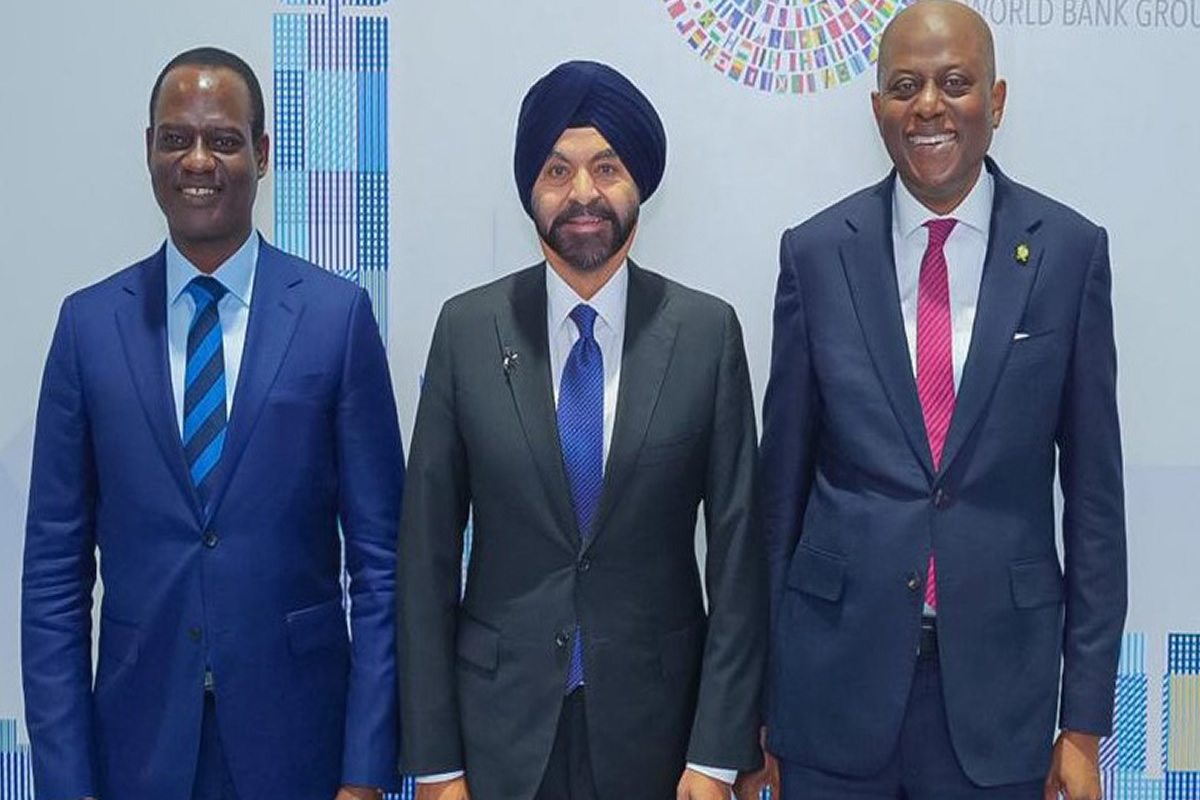
Nigeria’s finance minister and central bank governor review reforms with the World Bank chief, focusing on investment, infrastructure and revenue growth.
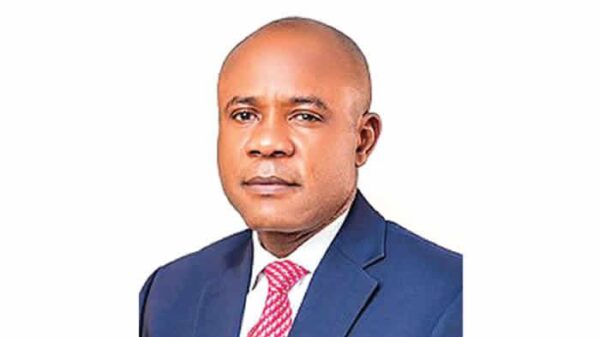
The Minister of Finance and Coordinating Minister of the Economy, Mr. Taiwo Oyedele, and the Governor of the Central Bank of Nigeria (CBN), Olayemi Cardoso, on Monday met with the President of the World Bank Group, Ajay Banga, on the sidelines of the ongoing annual meetings of the International Monetary Fund (IMF) and the World Bank in Bangkok, Thailand.
This comes as the World Bank Group identified artificial intelligence (AI) applications in agriculture, healthcare, manufacturing, tourism and infrastructure as key to creating jobs and boosting productivity in Nigeria and other African economies, urging governments to prioritise practical uses of the technology that address local economic challenges.
In the meeting with Banga, Oyedele who leads Nigeria’s delegation to the week-long meetings and Cardoso met with the World Bank chief to review the progress of Nigeria’s policy reforms, and the next phase of its agenda–turning macroeconomic stability into faster growth, more private investment and stronger domestic revenues.
In a statement issued by its Head, Media, Efe Ovuakporie the Ministry of Finance said Banga commended the progress of Nigeria’s reforms, pointing to the rise in private capital inflows from about $300 million in 2023 to nearly $6 billion in 2026, representing a “twentyfold increase.”
Oyedele highlighted the rising economic growth and noted that Nigeria’s tax-to-GDP ratio rose from about seven per cent to 12.5 per cent over the same period, adding that this gives the government more room to fund public investment without resorting to deficit monetisation.
The meeting discussed how Nigeria could make greater use of World Bank guarantee instruments, guarantees which could unlock financing for infrastructure and draw more private capital into the domestic market.
“Power infrastructure and human capital were identified as priorities for continued public investment, given their importance to business competitiveness, productivity and job creation. The meeting also stressed the quality of public spending, so that each naira delivers measurable economic and social returns.
“The meeting is part of the Federal Government’s wider engagement with development partners to lock in reform gains and attract new investment. As Nigeria moves from stability to growth, the priority is to turn stronger fundamentals into productive investment, more jobs and better living standards for Nigerians,” the statement said.
World Bank: AI Can Boost Jobs, Productivity in Nigeria, Other African Countries
Meanwhile, the World Bank Group has identified AI applications in agriculture, healthcare, manufacturing, tourism and infrastructure as key to creating jobs and boosting productivity in Nigeria and other African economies, urging governments to prioritise practical uses of the technology that address local economic challenges.
Banga, said the institution was placing job creation at the centre of its development agenda, with particular emphasis on deploying smaller, practical AI applications to strengthen businesses, improve access to essential services and expand economic opportunities for young people.
Speaking at the World Bank’s flagship event, ‘Small AI: More and Better Jobs,’ at the ongoing IMF and World Bank Group Annual Meetings in Bangkok, Thailand, Banga said developing economies could harness AI to improve productivity in sectors that already support millions of livelihoods.
He identified infrastructure, agriculture, primary healthcare, tourism and manufacturing as five priority sectors with significant potential to generate employment, particularly in economies where small businesses and informal economic activities account for a substantial proportion of livelihoods.
Banga said the scale of the demographic challenge confronting developing economies made employment creation an urgent priority for governments and development institutions.
“I believe that the bank’s entire focus has to be on jobs for a very simple reason: 1.2 billion young people in the coming 15 years are going to become 18 years of age, so that could be a huge demographic dividend,” he said.
He explained that the objective was to ensure that young people could participate productively in society through formal employment, entrepreneurship and other economic activities.
“So, the word job does not mean working for a big company or a small company or as an entrepreneur. It’s being productive in society, having a sense of optimism and a sense of dignity that comes from earning and being a part of that system. That’s what we’re talking about,” Banga said.
According to him, investments in infrastructure, education, healthcare and skills development must be designed with employment outcomes in mind, while governments should establish the conditions necessary for private businesses to invest, expand and create jobs.
“The bank’s entire focus has moved towards that over the last few years. It’s not that we don’t build a school, or we won’t build a highway, or we won’t build a skilling center or a healthcare clinic. We have to do all those, but we got to do them with the perspective of job creation,” he said.
Banga added that private capital would remain critical to employment generation, while governments must provide the infrastructure, governance and policies required to attract investment.
“Governments enable, and the private sector generates between 75 and 85 percent of jobs in any country. That’s what we’re trying to do,” he said.
For Nigeria and other African economies, the approach places emphasis on applying AI to existing industries, helping local producers overcome productivity constraints and enabling small businesses to reach wider markets.
In agriculture, Banga said AI-enabled tools could help smallholder farmers identify crop diseases, access information on agricultural inputs, obtain credit and connect with markets, thereby improving productivity and competitiveness.
He noted that small farmers in developing economies often struggled to compete because of limited access to technology, cooperatives and other support systems. Practical AI applications, he said, could help address some of these constraints and strengthen their participation in agricultural value chains.
In healthcare, AI could enable local clinics to connect patients with remote doctors and specialists, helping to bridge shortages of medical personnel and improve access to healthcare services, particularly in underserved communities.
The World Bank president also highlighted the employment potential of tourism, pointing to Thailand as an example of an economy that has developed the sector into an important source of jobs.
Manufacturing, particularly value-added production, was another priority, with Banga stressing the importance of creating local employment through production and processing rather than relying exclusively on the extraction of raw materials.
He argued that smaller AI applications could be particularly valuable in developing economies because they could address practical business and service-delivery challenges without requiring the resources associated with more sophisticated AI systems.
“The reality is that that large language models are estimated probably to create some degree of disruption in jobs in the developed world. By the time you get to middle-income countries and lower-middle-income countries, the actually the opportunity from small AI to build jobs and build productivity is enormous. That’s what we are trying to do, and that’s what the Jobs Council started out,” he said.
The approach comes as Nigeria and other African countries face the challenge of providing productive employment for growing youth populations while improving the competitiveness of domestic businesses.
The World Bank’s position suggests that AI could support job creation if it is deployed to strengthen existing economic activities, improve access to knowledge and markets, and help enterprises expand rather than simply replace human labour.
However, the employment implications of AI remain a concern among policymakers, particularly over whether productivity gains will translate into sufficient new jobs and whether workers will acquire the skills needed to adapt to changing labour-market requirements.
Meanwhile, the Managing Director of the International Monetary Fund (IMF), Kristalina Georgieva, and Singapore’s President, Tharman Shanmugaratnam, warned that AI could widen the gap between economic growth and employment if governments failed to prepare workers and economies for technological change.
Tharman said economic growth alone was insufficient to guarantee the creation of quality jobs, citing China, India and developing Southeast Asia as examples of economies experiencing growth alongside relatively weak employment generation.
“Growth is going to be critical to secure good jobs, but growth is not itself going to be sufficient to achieve those good jobs. And the evidence is already there. If you look at China, India, developing Southeast Asia, they’re growing quite well, but job creation is weak. So there’s already a divergence between growth and job creation, and AI is going to widen the divergence if we are too passive about it,” he said.
He urged governments to deploy AI in ways that support the creation of quality jobs, enable workers to develop their capabilities and provide opportunities for career progression, rather than allowing technological advances to deepen labour-market inequalities.
Tharman identified manufacturing, green energy and healthcare as sectors with continuing potential to generate employment. He also called for greater investment in skills development, internships, workplace experience and applied learning to prepare graduates for changing labour-market demands.
Georgieva, on her part, highlighted the potential implications of AI for public finances, warning that changes in the composition of employment could affect governments’ ability to generate revenue.
She explained that governments traditionally relied heavily on taxing labourincome, but a shift towards greater capital intensity and reduced demand for some categories of labour could require a rethink of taxation and public revenue systems.
“Think about the fiscal side of the story. Why? Because traditionally, governments would generate revenues by taxing mostly people. Well, if AI changes the structure of the labor market, and then there is less labor, more capital, what do we tax? How do we generate the revenues so governments can help play their most important role, which is help society adapt to the world of AI. If revenues are shrinking, they would be in a tough spot,” she said.
She highlighted the need for governments to prepare for the fiscal consequences of technological change while investing in education, skills development and other measures to help workers adapt.