

































































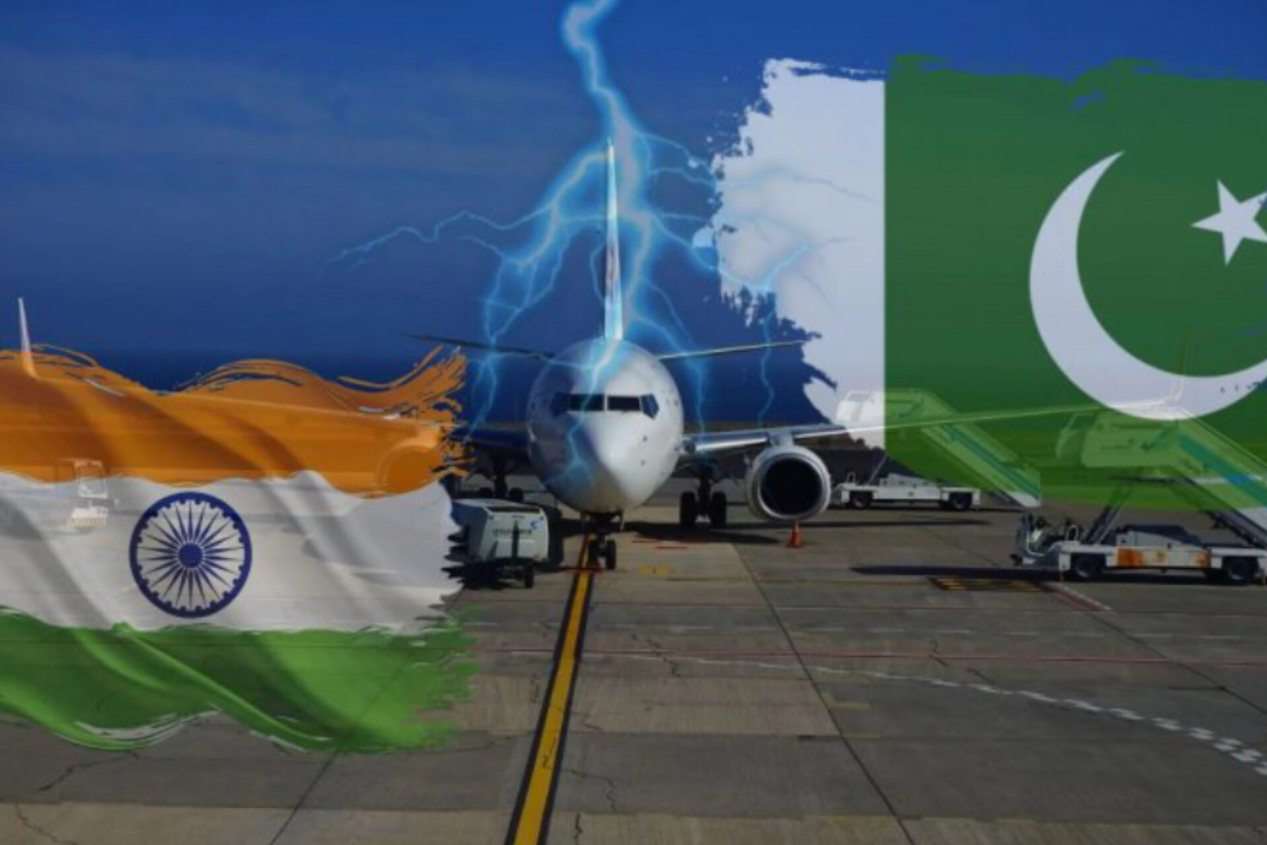

Pakistan restored access to its airspace for all commercial and military aircraft on Saturday after reaching a ceasefire agreement with India. The move followed several days of fierce cross-border conflicts, sparked by Pakistan’s missile and drone assaults on Indian infrastructure. These attacks were in response to India’s targeted strikes under Operation Sindoor, which sought to neutralize terror launchpads in Pakistan, prompted by the devastating Pahalgam terror attack on April 22 that claimed 26 civilian lives, predominantly Hindus.
An official announcement from the Pakistan Airports Authority confirmed that all airports nationwide had resumed regular operations starting at 5:00 PM IST. “Pakistan’s airspace has been completely reopened for all types of flights,” the statement declared.
Prior to the reopening, Pakistan had halted all flights and shut down several air routes, including those over Lahore and Karachi, due to the elevated risk of military operations. This closure led to considerable disruptions in global aviation, with numerous international flights being diverted or grounded.
The ceasefire agreement was officially disclosed by Indian Foreign Secretary Vikram Misri during a short press conference in New Delhi. Misri noted that the Director General of Military Operations of Pakistan had contacted his Indian counterpart at 3:35 PM IST. Both sides agreed to cease all military activities in the air, on land, and at sea, effective from 5:00 PM IST. Instructions were issued to ensure complete adherence to the agreement, with additional discussions planned for May 12 at noon.
Tensions had intensified following India’s strikes on terror launchpads in Pakistan and Pakistan-occupied Kashmir on Wednesday, which were a reaction to the Pahalgam attack. In retaliation, Pakistan launched drone and missile strikes targeting Indian military and civilian facilities along the western border. India countered Pakistan’s multi-domain offensive, which involved drones, fighter jets, and long-range missiles.
US President Donald Trump and his administration took credit for brokering the ceasefire. Trump claimed he had enabled dialogue between the two nations, and Secretary of State Marco Rubio tweeted that talks between India and Pakistan would soon occur at a neutral venue. However, Indian government sources clarified that no plans for talks beyond the ceasefire had been confirmed.
Pakistan’s Deputy Prime Minister, Ishaq Dar, acknowledged the ceasefire and verified its implementation at 4:30 PM Pakistan time. He cautioned that Pakistan would retaliate against any aggression from India, while also expressing gratitude to the international community for supporting the agreement.
With the airspace now reopened and diplomatic channels reactivated, the focus has shifted to whether the ceasefire will endure and whether Pakistan will uphold its commitment to peace or revert to its typical pattern of provocation.
A Gentle Reminder: Every obstacle is a stepping stone, every morning; a chance to go again, and those little steps take you closer to your dream.
Nnamdi Okoli