















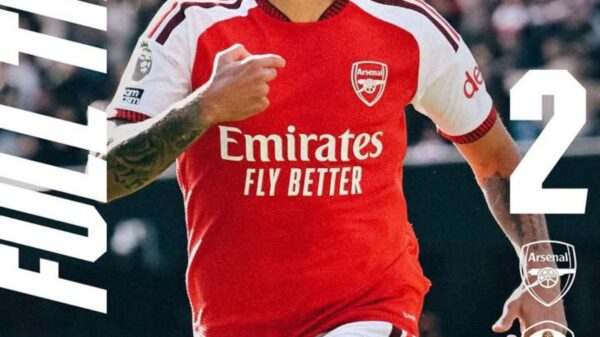



















































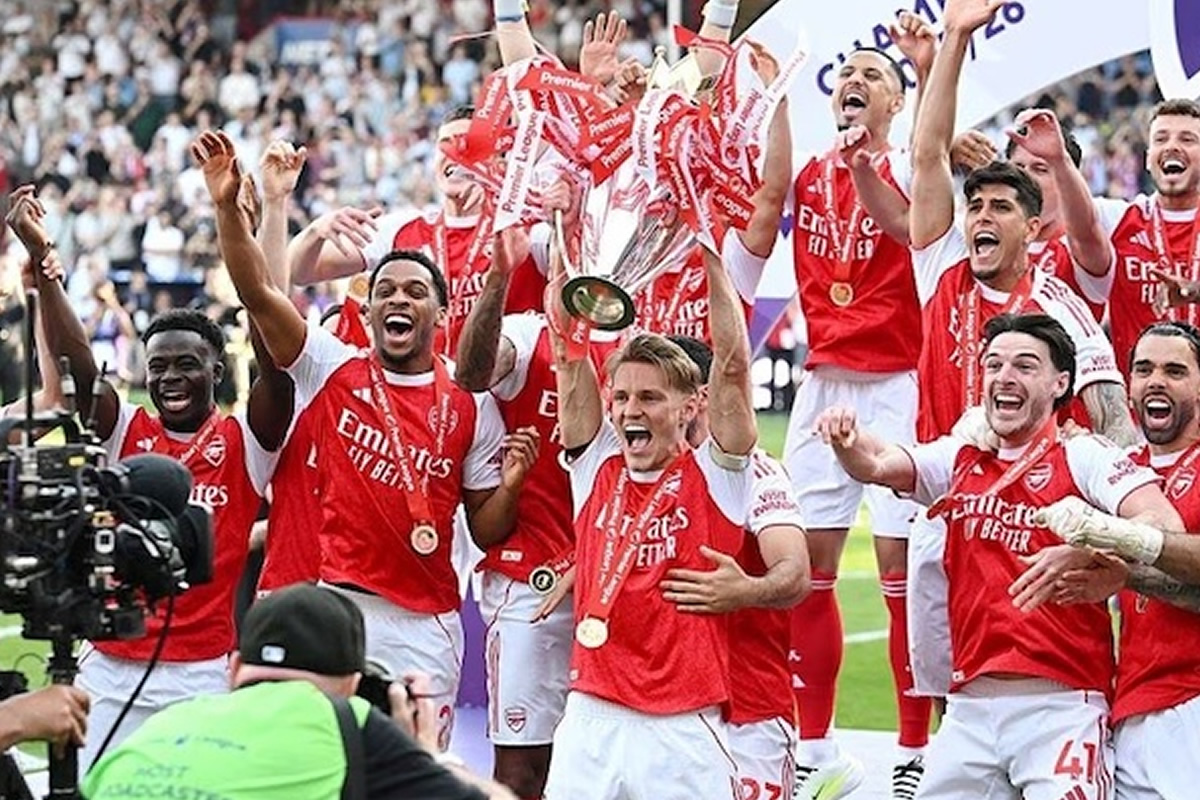
Arsenal’s enterprise value has surged significantly, rising by 23 per cent to €4.9 billion (about N7.84 trillion), in a development that underlines the club’s rapid financial growth ahead of its recent sporting success, including its first Premier League title in 22 years.
According to Football Benchmark’s latest ranking of European football club valuations, the North London club moved up two places to fifth in the continental standings.
The valuation is based on financial data from the 2024/2025 season and does not yet include the expected commercial uplift from Arsenal’s 2025/2026 Premier League title triumph.
The club is also preparing for a major European fixture, as it is set to face Paris Saint-Germain in the UEFA Champions League final on Saturday, May 30, 2026, at the Puskás Aréna in Budapest.
Football Benchmark data showed that Arsenal, with a €4.9 billion valuation, sits just behind Manchester United, which is valued at €5.1 billion. The report noted that this positioning brings Arsenal closer to the financial level traditionally associated with Manchester United and Manchester City.
The rankings also revealed a shift at the very top end of European football finance, with Manchester United falling outside the top three for the first time since Football Benchmark began publishing its valuations in 2016.
Real Madrid remains Europe’s most valuable football club, with its enterprise value rising by more than 20 per cent to €7.7 billion, while Barcelona is valued at €5.9 billion, highlighting the persistent financial gap between the two La Liga giants.
Football Benchmark attributed Arsenal’s valuation growth to broad-based revenue increases, particularly from commercial operations and other income streams. The report also highlighted a €246 million rise in squad value, which further strengthened the club’s position in the rankings.
Arsenal’s rise comes after a period of sustained sporting improvement. Before winning the 2025/2026 Premier League title, the club finished second in the 2024/2025 season behind Liverpool and ahead of Manchester City.
The North London side ended that campaign with 74 points, finishing three points ahead of Manchester City and 10 points behind Liverpool, before going on to win the following season’s title with a game to spare.
The triumph marked Arsenal’s first league title since the 2003/2004 “Invincibles” season, ending a 22-year wait and reinforcing the link between its sporting resurgence and growing commercial strength.
Football Benchmark noted that Arsenal’s enterprise value has nearly tripled over the past decade, driven by strong revenue growth and disciplined cost management.
The club is owned by US billionaire Stan Kroenke, whose broader sports portfolio includes the NFL’s Los Angeles Rams.
“In recent years, Arsenal has seen massive growth in terms of revenues and squad value,” Andrea Sartori, founder and chief executive officer of Football Benchmark, said.
Over the same period, Arsenal’s enterprise value has risen by nearly 200 per cent, outpacing several clubs in the upper tier of European football valuations.
However, Football Benchmark noted that long-term growth has been even more dramatic at Paris Saint-Germain, which has recorded an increase of more than 400 per cent, supported by Qatar Sports Investments and Arctos Partners.
PSG, who will face Arsenal in the Champions League final, ranks eighth in the valuation table despite playing in a relatively smaller 48,000-capacity stadium. The French club compensates for this with significantly higher matchday efficiency, generating one of the highest average revenues per seat at €147, compared with €101 at Arsenal.
Arsenal’s progress has come after several near misses in the Premier League title race, finishing as runners-up in the 2022/2023, 2023/2024, and 2024/2025 seasons.
In the 2023/2024 campaign, only two points separated Arsenal from eventual champions Manchester City.
In the 2025/2026 season, Arsenal also recorded 19 clean sheets on its way to securing the league title.
The latest valuation surge reflects a club that has combined sporting success with commercial expansion, positioning itself among Europe’s most financially powerful football institutions while chasing its first-ever UEFA Champions League crown.