





































































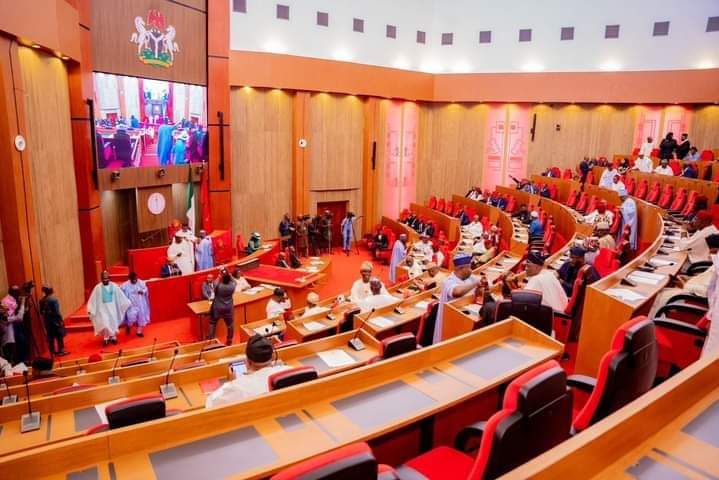
The long-awaited Constitution Alteration Bill, which aims to create state police throughout the federation, was passed by the Senate on Wednesday, marking a significant turning point in Nigeria’s decades-long efforts to improve internal security and decentralize policing.
After more than two-thirds of senators supported the proposal in a manual vote held during plenary, the historic legislation overcame a significant legislative obstacle.
Following the overwhelming support of lawmakers for the constitutional amendment, Senate President Godswill Akpabio declared the bill’s passage.
After Deputy Senate President and committee chairman Barau Jibrin presented and reviewed the Senate Committee on the Review of the Constitution’s report, the upper house passed the legislation.
Before senators approved the bill’s provisions and moved on to a final vote, it was first reviewed by the Committee of the Whole.
Senate Leader Opeyemi Bamidele, who is spearheading the measure’s debate, called on lawmakers to back what he called a crucial reform that would improve security, better respond to regional threats, and address the nation’s expanding security issues.
If the legislation is put into full effect, it will end the federal government’s exclusive control over policing by establishing a state policing framework that operates alongside the current federal police structure.
One of the main clauses gives state governors the authority to designate Commissioners of Police for their states, subject to state Houses of Assembly approval.
According to Clause 17 of the proposed amendment, each State Police Service will be led by a Commissioner of Police chosen by the governor and approved by the state legislature, while the Inspector-General of Police will still be in charge of the Federal Police Service.
The bill also defines the operational relationship between governors and state police commands.
Section 17(6) provides that governors may issue lawful written directives of a general policy nature to state Commissioners of Police on matters relating to public safety and public order.
To address longstanding concerns over possible abuse of state police by political office holders, lawmakers incorporated safeguards designed to protect civil liberties and political freedoms.
Section 17(7) stipulates that a state Commissioner of Police shall not arrest, detain, investigate or deploy force against any person, political party or group merely for criticising the government, except in accordance with the law.
The provision is intended to prevent the use of state police formations against political opponents, journalists, activists or dissenting voices and to ensure that all actions remain subject to due process.
The passage of the bill came barely an hour after the Senate abandoned plans to use an electronic voting system for consideration of the State Police Bill and other constitutional amendment proposals.
After worries surfaced that technical issues with certain voting devices could deny senators their right to vote and jeopardize the integrity of the process, lawmakers decided to vote by hand.
Bamidele’s motion, which contended that each senator should have an equal chance to take part in the historic vote, was followed by the decision.
Akpabio backed the idea, arguing that an open voting procedure would ensure full participation and foster transparency by letting Nigerians know where their representatives stood on important constitutional amendments.
Several senior government officials witnessed the proceedings, including Kaduna State Governor, Uba Sani; Ogun State Governor, Dapo Abiodun; Ondo State Governor, Lucky Aiyedatiwa; and the Chief of Staff to the President, Femi Gbajabiamila.
Following the adoption of the motion, senators were called individually to publicly declare their votes on the constitutional amendment proposals.
The successful passage of the State Police Bill represents one of the most consequential constitutional reforms undertaken by the 10th National Assembly and could significantly reshape Nigeria’s security architecture if it secures the approval of state Houses of Assembly and satisfies other constitutional requirements.
Nigeria’s centrally managed police force, according to proponents of state policing, is overburdened and unprepared to deal with banditry, terrorism, kidnapping, communal violence, and other security risks.
However, detractors still worry that governors might use state police systems to intimidate opponents and stifle dissent.
Nigeria has taken a big step toward establishing state-run police services that would work alongside the federal police system with the Senate’s approval. Many people think this reform could completely change the way the nation approaches security and law enforcement.
Live with Purpose, Love with Passion. Remember to be happy
One ❤️❤️❤️
Rose Ajieh